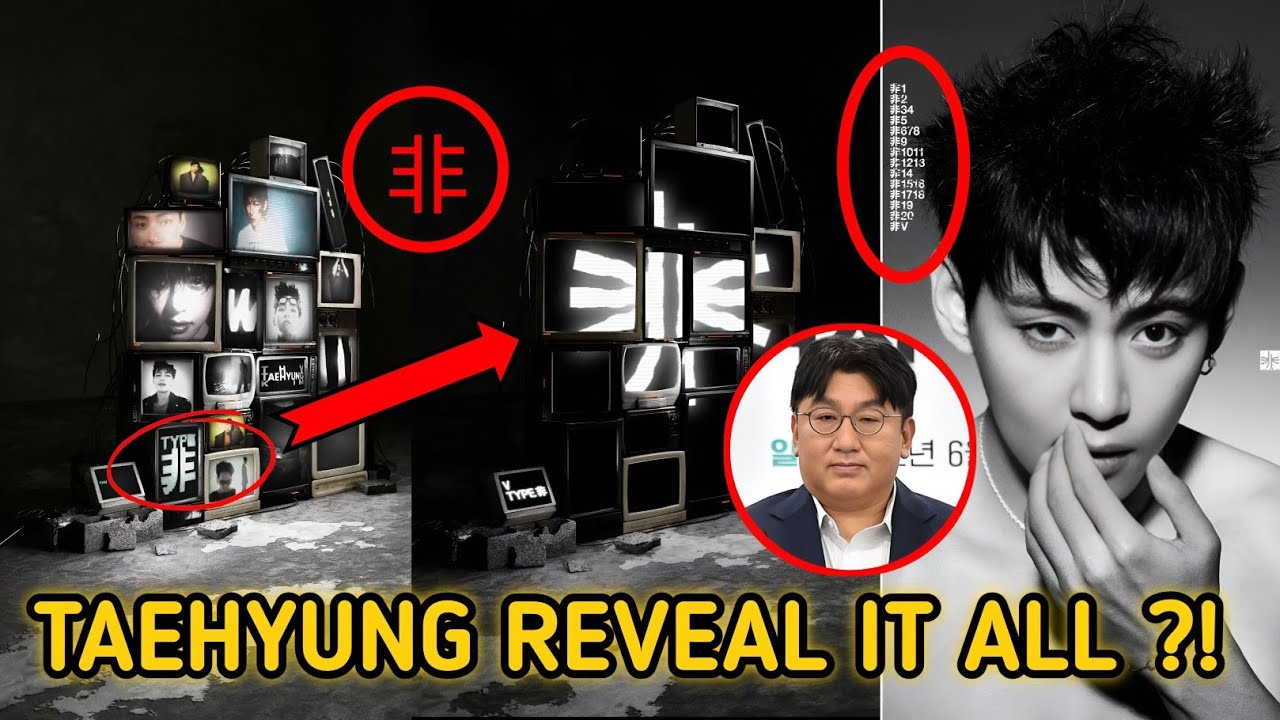
A mysterious new project has emerged from BTS member Taehyung, also known as V, and it’s leaving fans buzzing with curiosity. The enigmatic phrase “TYPE 非” has surfaced, sparking intrigue and speculation about its deeper meaning and what it signifies for Taehyung’s artistic journey.
Instead of providing a straightforward explanation, Taehyung has opted for an approach filled with ambiguity and visual storytelling. The term itself, particularly the character 非, suggests a rejection of traditional classifications and expectations. In many East Asian contexts, this character conveys meanings like “no,” “against,” or “outside,” hinting that Taehyung is challenging the norms of how he is perceived as an artist.
Visually, the concept of TYPE 非 presents a stark and unsettling aesthetic. With its minimalist design—layered screens and scattered light—it evokes a sense of observation and introspection. This is not your typical pop music project; it feels more like an avant-garde art installation that encourages contemplation rather than comfort.

What makes TYPE 非 particularly compelling is its alignment with Taehyung’s artistic evolution. Over the years, he has consistently defied expectations, whether through his musical choices, visual imagery, or even moments of silence. This new endeavor appears to be a continuation of that rebellious spirit, yet it feels more assertive and intentional.
There’s also a poetic resonance in the visual similarity between “no type” and the letter V when broken down into lines. This overlap blurs the lines between Taehyung’s name, his identity, and the concept itself, suggesting a fluidity that transcends mere persona. It’s not about playing a role; it’s about existing authentically.
Fans are left wondering: is this a musical project, a visual art piece, or something entirely different? The uncertainty seems deliberate, as Taehyung shifts the power dynamics, inviting his audience to interpret rather than consume. In a fast-paced world, TYPE 非 embodies a stillness that invites reflection.
The emotional weight of this project is palpable. It carries a sense of introspection and solitude, as if Taehyung stands at the crossroads of public persona and private self. This isn’t a rebellious act for shock value; it’s a quiet challenge to simplify his complexity.

If TYPE 非 is indeed a new venture, it seems designed for those willing to embrace uncertainty and recognize that not everything meaningful requires a clear explanation. It stands on its own terms, asserting that it doesn’t need validation to exist.
Underlying this concept is a tension between visibility and invisibility. The fragmented images and shadows suggest that Taehyung is offering pieces of himself rather than a complete picture, prompting audiences to confront the discomfort of not knowing everything at once.
There’s also a nostalgic element, with vintage screens and analog silence contrasting sharply with our digital age. This project may not just reflect Taehyung as an artist but also comment on how identity is presented and distorted in a media-saturated world.
The absence of color in TYPE 非 is significant too. It strips away distractions, presenting a stark contrast that invites viewers to discover their own emotions. This intimate exploration feels like reading an unspoken thought, meant to resonate deeply.

Ultimately, TYPE 非 doesn’t compete for attention or scream for interpretation. Instead, it patiently awaits understanding from those who are meant to grasp its essence. This level of restraint is rare, showcasing an artist who is fully aware of his place in the world.
If this project is tied to HYBE, it signals a fascinating shift, allowing Taehyung the freedom to explore beyond commercial expectations. If not, it boldly asserts his independence as an artist. Either way, TYPE 非 exists in a realm where conventional expectations hold little weight.
In the end, this isn’t just a promotional teaser; it’s a pivotal moment for Taehyung, a quiet declaration of his current state. There’s no need for justification, and perhaps that’s why TYPE 非 lingers in the mind—it leaves an impression without demanding to be revisited.
As this journey unfolds, one thing is clear: TYPE 非 invites us to experience rather than merely observe, challenging us to ponder what it truly means to grow. What lies ahead in this artistic exploration?