McLaren’s stunning resurgence at the Japanese Grand Prix revealed a hidden secret in the Mercedes engine, exposing a legal loophole that grants an unfair advantage impossible for rival teams to replicate. The FIA confirmed this engine anomaly is legal but vowed to close the loophole soon, igniting a fierce race against time and reshaping this season’s battle for supremacy.
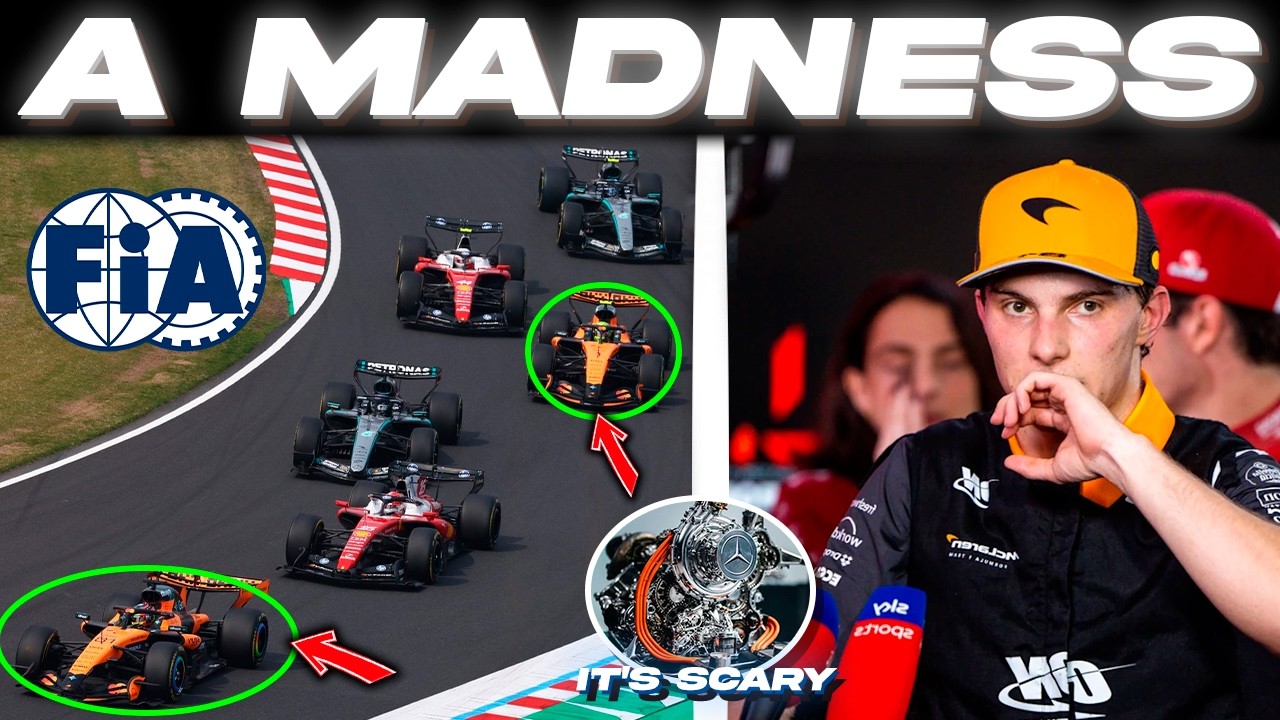 At the heart of McLaren’s sudden leap from lagging contender to front-runner lies a radical reinterpretation of the Mercedes power unit. Unlike mere tuning or strategy tweaks, this breakthrough exploits a regulatory blind spot involving the engine’s compression ratio. McLaren’s engine performs differently once it reaches optimal racing temperatures, producing more power than is theoretically allowed without breaching formal rules.
This thermally-driven enhancement grants McLaren explosive initial acceleration, particularly off the line, where the difference in milliseconds translates into crucial positions gained. During the Japanese GP start, this mechanical marvel became undeniable as McLaren surged with an uncharacteristic burst unmatched even by dominant teams, leaving rivals scrambling for answers.
The FIA’s post-race investigation unveiled what experts had long suspected: Mercedes’ engines behave in ways the regulations can’t presently capture. By designing an engine whose internal geometry shifts at race temperature due to specialized materials and thermal expansion, Mercedes creates an effective on-track compression ratio higher than static measurements permit, perfectly straddling legality.
What makes this advantage especially bitter for competitors like Ferrari, Honda, and Audi is its fundamentally uncopyable nature. Teams can’t simply replicate it by tweaking settings or parts mid-season. Doing so would require a foundational engine redesign—altering materials, tolerances, and designs—all blocked by strict development and homologation constraints, locking others out of this secret advantage for now.
 This engineering masterclass arrives at a pivotal moment as McLaren, fresh from resolving earlier reliability woes, can now unleash this raw power without compromise. The combination of newfound reliability and Mercedes’ unique engine innovation propels McLaren into championship contention, turning them overnight from underdogs into serious title challengers.
The FIA’s stance is equally remarkable. Instead of immediate bans or retroactive penalties, they have chosen a deferred regulatory fix. This approach grants McLaren and Mercedes a temporary but invaluable competitive window to maximize gains while preparing new measurement protocols that will ultimately close the loophole and level the playing field.
With the clock ticking, each subsequent race transforms into a high-stakes sprint. McLaren knows it must capitalize on this fleeting advantage now, as the impending rule adjustment will eliminate the edge. This transient power window elevates the intensity on the grid, with every point potentially decisive before equilibrium is restored.
A deeper technical review reveals Mercedes’ cunning use of materials engineered for precise thermal behavior. When heated to operating temperatures, these materials subtly alter the cylinder’s internal shape, increasing compression beyond allowances measured under controlled, cold conditions. This scientific ingenuity bypasses the FIA’s static measurement rules, exploiting an unregulated variable.

Competitors face a daunting reality. To compete, they would need extensive redesigns that cannot be rushed without risking reliability and engine durability—cornerstones in Formula 1’s grueling development environment. The complex interplay of costs, regulations, and timelines means Ferrari, Honda, and Audi are stuck playing catch-up, hindered by legacy designs and regulatory shackles.
McLaren’s leap in Japan was no mere accident. It was the first real demonstration of this engine philosophy in full racing conditions. Their immediate acceleration off the start not only stunned rivals but also validated the effectiveness of the Mercedes power unit’s thermal advantage. This potent combo places McLaren in a strategic position unlike any they’ve held all season.
Moreover, this isn’t limited to race starts. The extra horsepower affects restarts, traction zones, and wheel-to-wheel battles, making McLaren’s car more aggressive, defensively robust, and offensively capable. This makes overtaking harder and defending easier, transforming race dynamics and significantly altering how competitors must strategize through the race weekend.
 Looking ahead, once the FIA implements new measurement standards, the advantage will vanish. This pivotal moment will reveal the genuine performance hierarchy on the grid, clarifying whether McLaren’s revival is sustainable or a fleeting phenomenon powered by regulatory interpretation. Until then, the championship fight plays out under a shifting, high-stakes landscape.
The current scenario underlines a fundamental truth in Formula 1: innovation isn’t always about sheer power but mastering the art of interpreting and exploiting regulations precisely when it matters most. McLaren, backed by Mercedes’ unmatched technical ingenuity, has seized this moment, rewriting the script mid-season and reshaping the championship before rivals can react.
This revelation also prompts broader questions about the FIA’s enforcement timelines. Allowing several races before closing this loophole has handed Mercedes and McLaren a crucial competitive edge, sparking debate over regulatory response speed and fairness. Was this strategic patience or a lapse? The championship’s unfolding 𝒹𝓇𝒶𝓂𝒶 may provide answers.
In conclusion, McLaren’s remarkable turnaround powered by Mercedes’ enigmatic engine advantage is reshaping the F1 season. The ticking clock on the FIA’s upcoming regulation changes adds urgent 𝒹𝓇𝒶𝓂𝒶: will McLaren convert this temporary edge into lasting success, or will the grid new order revert post-intervention? Every race until then is a do-or-die battle.
As fans and teams brace for this technical arms race escalation, the Japanese Grand Prix stands as a turning point—showing that in elite motorsport, victory often hinges not solely on speed, but on innovation with surgical precision and impeccable timing. McLaren’s rise signals a thrilling new chapter in this year’s relentless championship saga.