At the Australian Grand Prix, George Russell’s fastest lap sent shockwaves through the Formula 1 paddock, with none other than Lewis Hamilton stunned into deep analysis. Hamilton’s insight reveals a potential seismic shift in the balance of power, suggesting Mercedes may have unlocked a groundbreaking technical edge under new regulations.
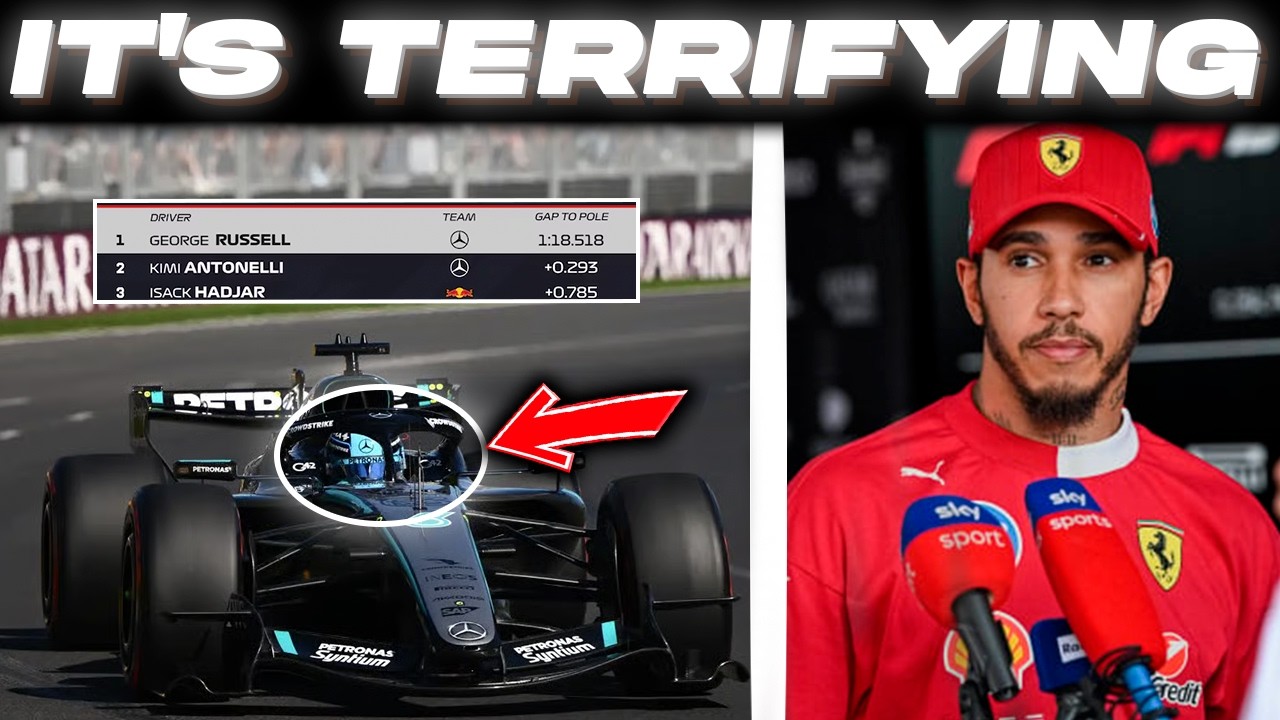 Russell’s blistering lap time wasn’t just a moment of brilliance; it was a statement that disrupted expectations immediately. The margin he put between himself and rivals was far greater than the usual fractions of a second that define F1 battles. This unexpected dominance ignited urgent discussions about Mercedes’ qualifying capabilities.
Lewis Hamilton, a seven-time world champion intimately familiar with Mercedes’ inner workings, provided a rare, nuanced commentary. His observations pointed to a sophisticated harmony between chassis design, aerodynamic efficiency, and hybrid energy management—elements perfectly synced to maximize performance during a flying lap. This trifecta explains the formidable pace Russell displayed.
According to Hamilton, the real magic lies in managing every component of the car’s systems as a seamless whole. Energy recovery, power deployment, mechanical balance, and aerodynamics must align flawlessly. Mercedes’ new approach appears to have achieved this delicate equilibrium, a feat that could redefine qualifying and race pace.
The significance of Russell’s lap extends beyond raw speed. It symbolizes a potential technical breakthrough, as the team’s car demonstrated balanced efficiency across all sectors of Albert Park’s challenging layout. This is no isolated incident but a possible blueprint for dominant performance throughout the coming season.
Inside the paddock, engineers and rivals are scrambling to decode data from Russell’s lap. The scale of Mercedes’ advantage raises the critical question: has the German powerhouse uncovered a more effective interpretation of the recent technical regulations than their competitors?
Ferrari’s struggles during the weekend provide a stark contrast. Unlike Mercedes’ apparent ease, the SF26 remains a work in progress with unpredictable handling and inconsistent pace. Hamilton’s firsthand experience driving both cars offers invaluable perspective on the challenge of finding a stable operating window amid new regulations.
Russell’s confident driving underscored the car’s stability and responsiveness. Every corner attacked with precision, every acceleration executed with control—this level of harmony typically emerges only when a car is perfectly dialed in. Such synergy empowers the driver to push boundaries without hesitation or risk.
 This development could reshape the competitive landscape of Formula 1 this year. An early-season advantage of this scale can set the tone for upcoming races, forcing rivals to rethink strategies and innovations under pressure to catch up with Mercedes’ newfound edge.
Hamilton’s subtle yet insightful commentary serves as a quiet alarm bell for the paddock. His expertise lends weight to the theory that Mercedes’ leap is no accident but a carefully engineered mastery of the sport’s complex technical environment.
The horsepower jump hinted by power unit performance discrepancies raises further intrigue. Hamilton alluded to Mercedes’ engine’s torque and compression characteristics, signaling potential FIA scrutiny and ongoing efforts to balance performance across the field.
Australian GP’s early stages revealed much more than racing excitement; they 𝓮𝔁𝓹𝓸𝓼𝓮𝓭 the underlying battle for supremacy shaped by regulatory savvy and engineering excellence. Russell’s lap could be the harbinger of a season dominated by Mercedes yet again.
Teams now face the delicate race off-track to decode and counteract Mercedes’ advantage. The urgency is palpable, as rivals must accelerate their development programs or risk falling irreparably behind this rapidly evolving benchmark.
The implications reverberate beyond raw speed. A car operating perfectly across all performance factors influences tire management, race strategy, and driver confidence—key ingredients in accumulating championship points consistently over a long season.
Russell’s performance fueled by Mercedes’ stable platform contrasts sharply with the turbulent development cycles of other teams. This clarity in rollout and feedback loop demonstrates an organizational strength that could prove decisive in the months ahead.

Hamilton’s new role as a perceptive analyst on the grid adds an intriguing layer. With deep knowledge of his former team and firsthand insight into rivals’ challenges, his measured comments provide critical clues about where the championship momentum might be heading.
His acknowledgment that the car seems “much more comfortable” operating in its ideal window implies a technical maturity rarely achieved so early, offering Mercedes a tactical advantage in both qualifying and race conditions at circuits worldwide.
The wider paddock is on high alert, focusing intensely on the evolution of Mercedes’ car and power unit as the season progresses. Every session from here will be closely scrutinized for signs of whether this advantage is sustainable or conditional.
Albert Park’s challenging circuit layout served as the perfect proving ground. Russell’s balanced lap demonstrated control without compromises, blending speed with stability—a potent combination that rarely emerges by chance on the first race weekend.
The FIA’s role in balancing engine performance could become a focal point of contention. Hamilton’s hints about compression ratios and torque management suggest regulatory oversight may intensify as teams seek clarity on what constitutes fair competition.
Amid mounting speculation, Mercedes remains tight-lipped but focused on their operations. The message is clear: this performance is a product of deliberate engineering prowess rather than circumstantial luck, setting a new standard for rivals to chase.
 Russell’s early dominance places him as a formidable contender alongside Hamilton, signaling a potent internal rivalry that could drive the team’s performance even higher while keeping competitors on edge.
As the championship unfolds, this initial signal from Australia demands attention. The lap time was more than a statistical outlier—it was a revelation that could dictate the direction of Formula 1’s competitive hierarchy this season.
Fans and analysts alike will be watching closely, aware that moments like this rarely pass without profound impact. Russell’s lap, as decoded by Hamilton, might just be the quiet beginning of a Mercedes-era resurgence.
In a sport defined by minute margins and relentless innovation, Mercedes’ apparent mastery of the complex new rules sets a dramatic stage. The countdown to whether rivals can respond effectively has begun in earnest.
The unfolding story from the Australian GP signals a thrilling, high-stakes battle on and off the track. Every sector, every lap, and every strategic decision will be magnified under the spotlight cast by Mercedes’ explosive qualifying performance.
This breakthrough challenges every competitor to elevate their game immediately, or risk watching a familiar powerhouse chart a course toward another championship run with razor-thin margins leaving no room for error.
With Hamilton’s insights illuminating the technical intricacies behind Russell’s fastest lap, the Formula 1 world confronts a crucial question: will this performance crescendo into total dominance, or will it ignite the fiercest development race seen in years?
One thing is certain—Australian Grand Prix 2024 has set the tone for a season brimming with intrigue, innovation, and intense rivalry, propelled by a lap that has everyone questioning the status quo and demanding answers fast.
Source: YouTube